Sharpening your stand
A meditation on Sharpeners and Stands

“Harsh, what is Ambidextrous?” a student asked as I was taking the class. I answered, “A person who can use both their hands with equal comfort and skills, like Virus of 3 Idiots.” They started solving the given sheet of filling the blanks with GRE words. I roamed around in the class to look at their answers. And it caught my eye. An object that seemed foreign. Stationery has always been fascinating. More so now when there are so many foreign companies in the market and innovating things beyond the Natraj, Apsara, Faber Castel era that I grew up in. I spotted an eraser. An eraser that had its own cover. It was like a small suitcase. A suitcase for eraser. I felt under-dressed cause I was in my regular clothes- A t-shirt and a pair of jeans. The suitcased eraser seemed like a sophisticated version of the childhood I had. Something that I knew but never knew it in that way. I saw it and remembered the glass covered sharpener.
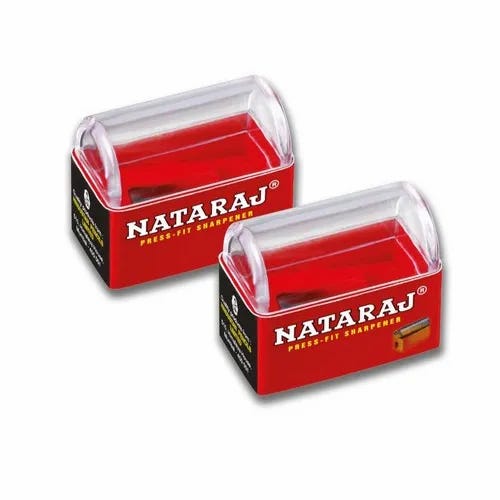
This is the sharpener that I used among few other case-less variants. The long point one by Apsara, the classic one by Natraj, and sometimes the exotic Faber Castel. There were some by Camlin and Camel as well but they were rare. This one is special cause it had this casing. The other ones did not and would require you to visit the dustbin area to sharpen. It was also expensive compared to the non-cased ones so that added to its importance.
As I remembered about sharpeners and their distinct forms, I thought about how they were invented and how did they evolve. I did ask AI about it and below is a small and quick version of its evolution. You may skip this if you would like to. I would write a point of resumption post that and you may continue from there.
The Evolution of Sharpeners
The first sharpener per say was a pocket knife. Everyone, including children would carry them to sharpen their pencil. It was a simple idea of shaving the lead with the knife. This is almost like the stone age of sharpeners. The early humans used stones and pointed stuff to sharpen their weapons. This minimized it and used it on pencils.
And the downside was obvious- Cuts on hands, injuries, pocket cuts, and even loss of lives in the rarest cases because of a wrong angle or a septic blade. All of this lasted until 1828, when a mathematician named Monsieur Bernard Lassimonne thought it is too frustrating and bad to keep on doing so whenever he wanted to write something.
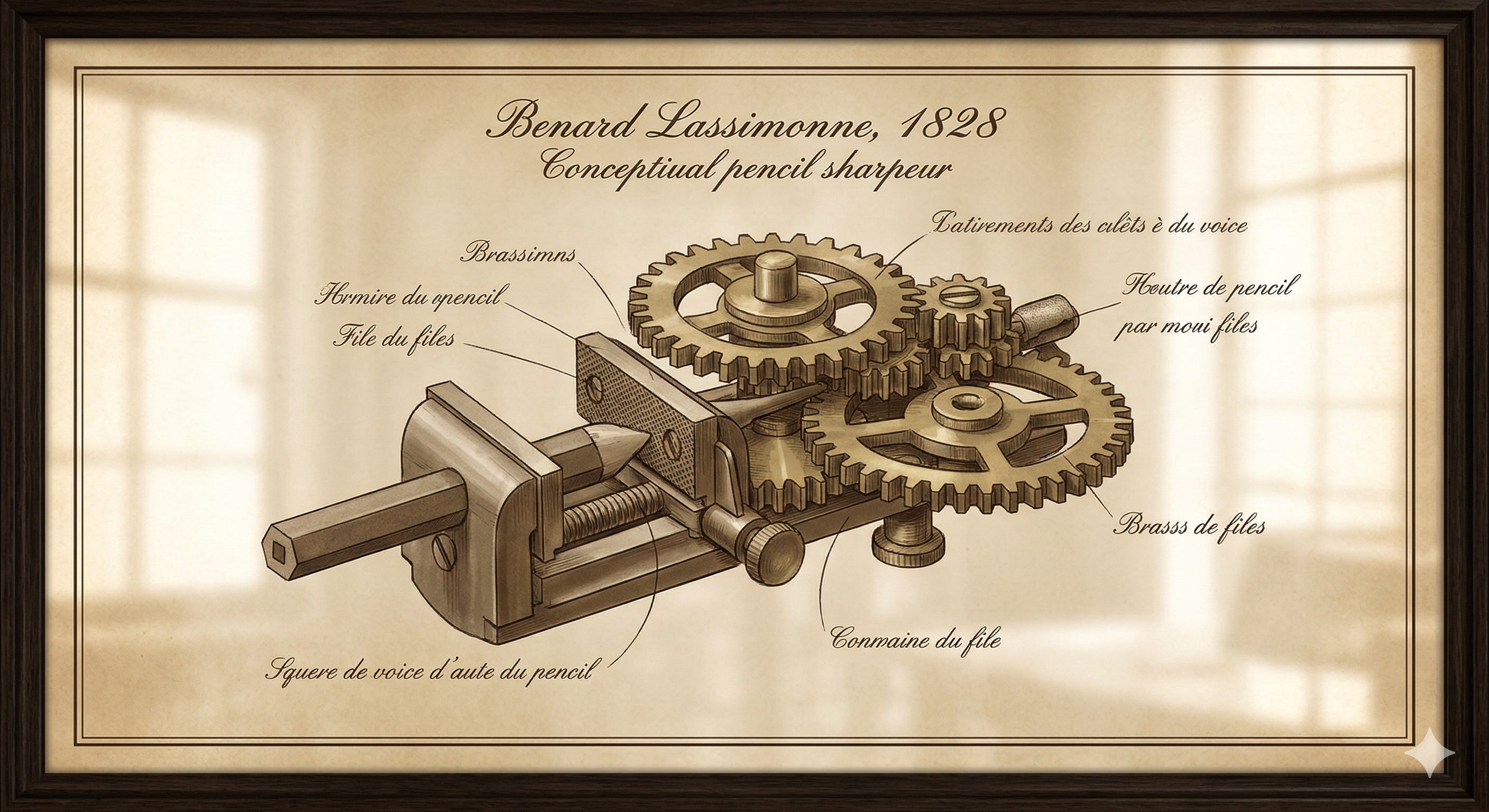
The Gearbox (1828) :
Monsieur Bernard Lassimonne came up with a giant design that employed brass gears to sharpen the point. It was of a massive size and you would need to employ a lot of effort to just move the gears for a sharp point. Think of grinding wheat or coffee by hand. It would be the size of a brick but it would be really heavy. Heavy enough for it to be used as a paperweight as well.
People did not like it as much and thought it was as good as knives but with more efforts and weight.
The Pocket Revolution (1847)
Lassimonne’s sharpener was there until 1847, when a guy named Thierry des Estivaux had a light bulb idea. He realized that you did not need massive gears but just a small blade inside a cone. It is the design that you probably use today. The one that is widely employed. It fits right in your pocket. Probably your tiny watch pocket in your jeans pocket as well.
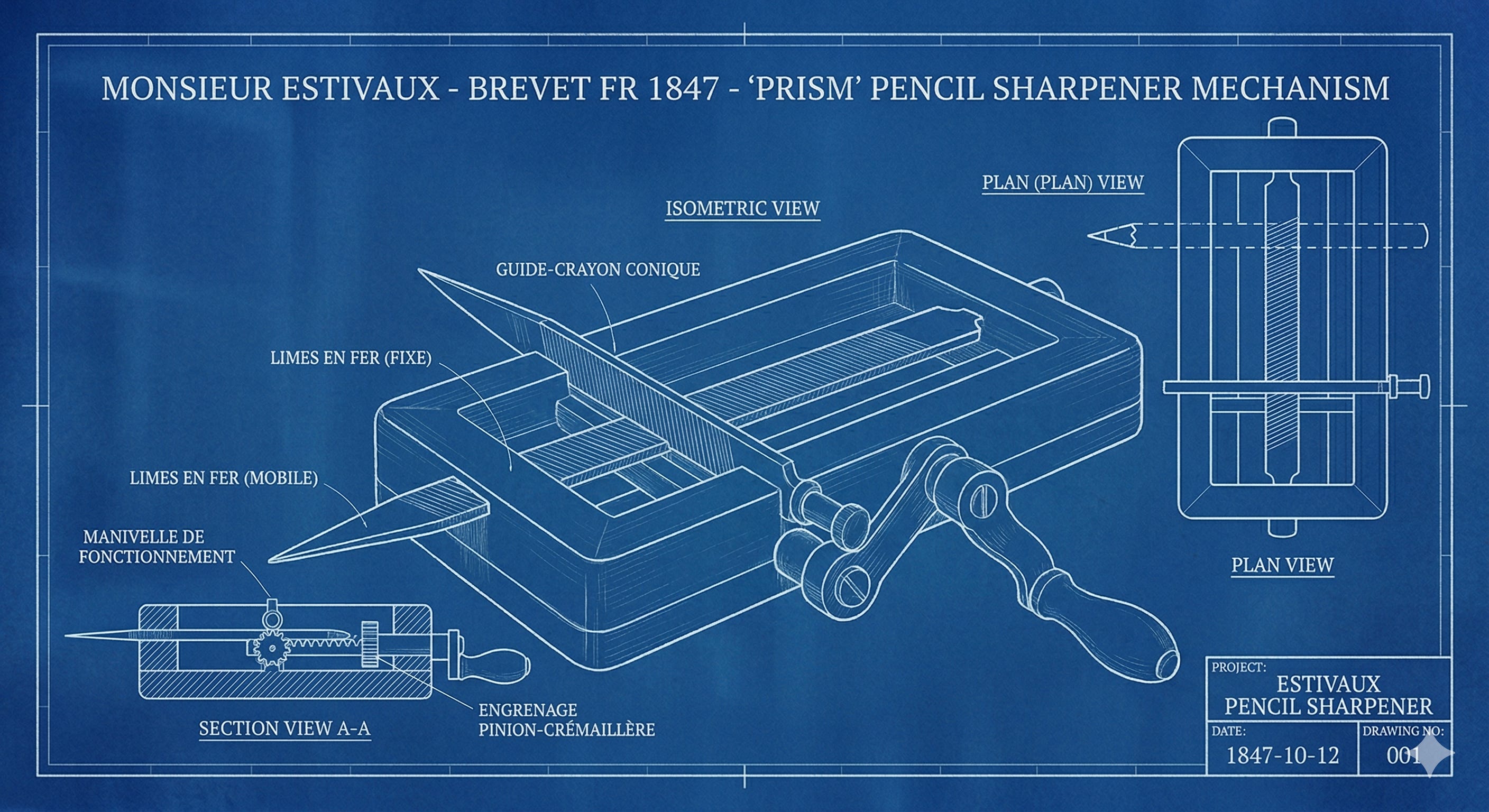
In fact, it was Walter K. Foster in 1855 that applied this patent and put it to commercial factory made versions that made it widespread and commonly accessible.
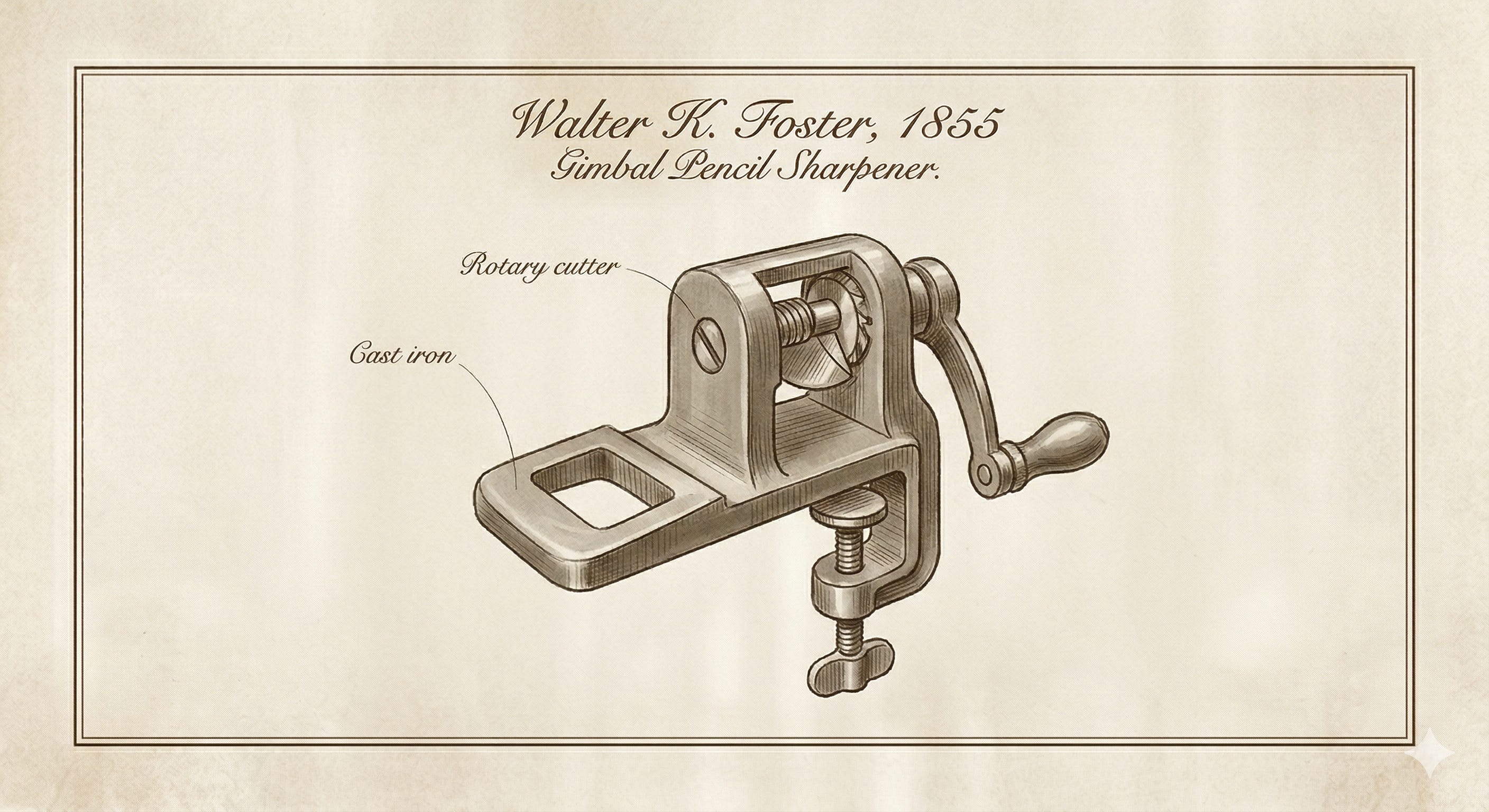
Now that we had pocket sized sharpeners and things were simple, easy, and ready to go, we would have taken a backseat and relaxed, right? No. These were still problematic as they would often lead to broken leads and were prone to breakage of the pencil or the lead. You have experienced this. Sometimes, you did so intentionally just to buy time. Confess it.
And behold, there comes the giant machines-
Styloxynon & Crank Machines (1890s)
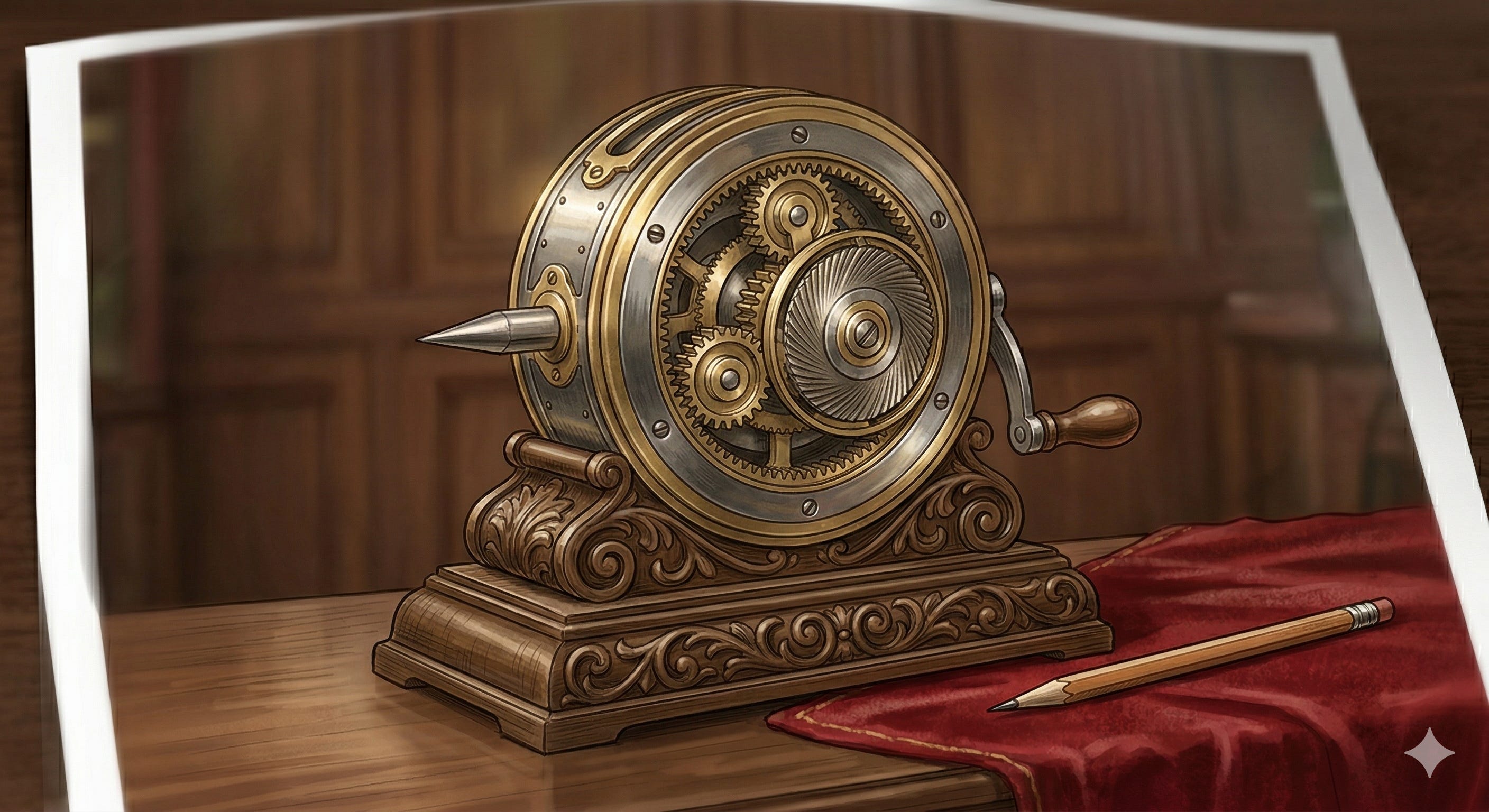
These were big, precise, and solved a massive problem. The breakage of leads and sometimes the pencil due to wrong usage or mistakes would be eliminated. These were mounted on walls or desks and would eliminate the need to hold it while we just pulled the lever. It also were the ornate designs that would attract people to buy it and no wonder they were so popular in the Victorian Era.
The Modern Mix
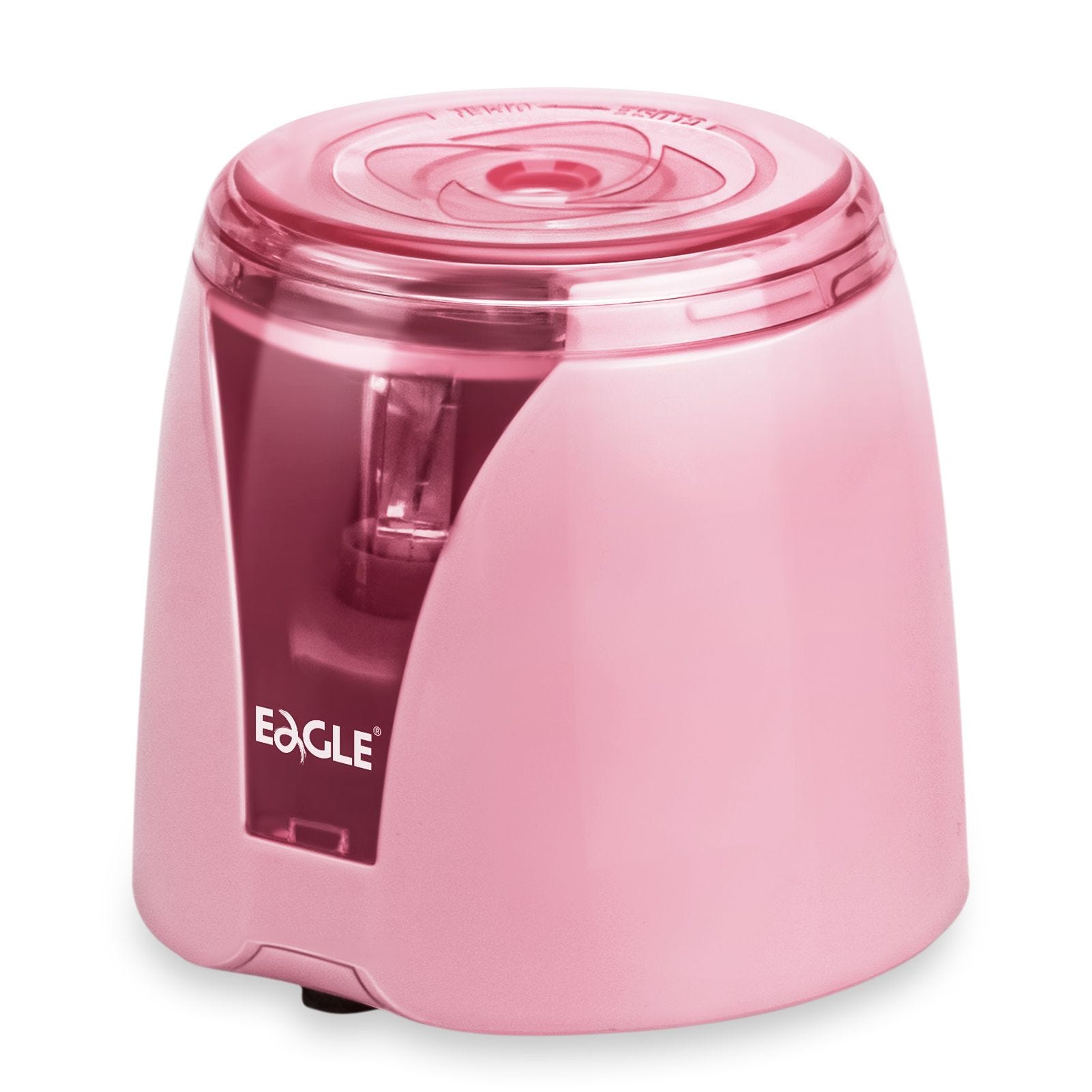
You are already aware of the modern sharpeners. Sophisticated. Modern. Sleek, and portable. USB Charged, battery powered, handy, inside a power bank, automatic, or anything that you could probably think of might be a possibility today.
Resume Now
One of the best things about the sharpeners were that you could sneak out in the class and talk with your best friend while pretending to be busy. I think that is a fond childhood memory that most of us share, irrespective of libraries being replaced by AIs or assignments being written by hand or on computers. You would get a break. A break that would snap you out of boredom and connect you with your interesting side. Also, if you were a tad bit creative or you just wanted to be a child, you would collect the shavings to create art or flowers.
And then you would return. You had sharpened your pencil. Suddenly, your writing feels accurate. You feel like writing more and even drawing. It is like a hidden potential is unlocked. No wonder people also say things like sharpen your saw to be better at whatever skill you want to be better at. The small tool giving you access to a better version of the pencil. A better version of writing. A better version of creation. A better version of yourself. It is but a marvel that we do not stop and think about these little beautiful things that make our lives simplistically so beautiful and charming.
While your brain takes this flight of fancy, the class gets over. Finally, you are free to go and play out with your friends. It is recess and it is time for some food, some play, and a lot of shouting, screaming, and running. You put the pencil and sharpener in your pen stand cause you do not want to go through the hassle of putting and removing it from your compass box.

It lays there in the pen stand. Sharp. Accurate. Ready to roll. It is a thing of beauty. With it lays multiple other things. The pencils, the pens, the eraser, the colors, the stapler, the pins, the brush, and even the dreaded red pen. The stationery becomes stationary. Maybe that is why they are homophones. And no wonder it is called pen stand. It stands and waits.
Like you do when you have reached early to the airport cause the flight requires you to be there at least 2 hours before the time. Now that you have reached there, of course Indigo has decided to be late and you have 3 hours instead of 2 to kill. There you stand. You wait and witness the peace in the commotion. You witness the plane landing on the runaway and coming to its designated spot. A ladder stand being attached to it. And then you wonder how universal is a stand. Is it the pen stand that we put our pencils in? Is it the one attached to the planes so that we can board and depart from it in a smooth and easy manner? Or is it the stand in the stadium where you would shout at the top of lungs with millions of others to feel a part of this galaxy where everyone at that time feels like the same mind being present in different bodies? Same feeling resting in millions of people? And there you realize. It is but natural to stand.

The stand of the keyboard gives it a position to start playing. The stand of the pen gives it a place to exist and carves the identity of that spot. The spot of writing, creation, innovation, and art. You stand there to see it. Thousands of thoughts cross your mind. Hundreds of emotions engulf you. Grief, joy, disgust, contempt, surprise, wonder, anger, awe, and every combination that you can think of.
What is a stand? Is it just to rest? Or is it to breathe and take a moment of pause before you blast out with full energy to conquer the world? Or is it simply the tool on which my laptop rests as I type this? It is but a simple word. STAND. 5 letters. Multiple uses. Multiple connotations. A pause, rest, a break, a standstill, a closure, an end, a stance, an opinion, a reset, an observation, and even a beginning.

What is it to stand? It is what you want it to be. You stand where you want to. There is no need to necessarily stand by someone when you clearly do not understand their stance or nuance. Perhaps you could just stay on stand by unless you have a clear plan and observation to know what to do next. It is all you. It is your eyes, ears, wisdom, experiences. Who am I to define it?
"Sir, we are done.” one of the students say as they complete their assignment. I look at them and realize that I have been a bystander for a long time. It was time to resume, time to begin, so I took the marker from the pen stand and began the discussion about how to sharpen their word skills for the assignment.
Thank you for reading. Other posts that you can check out- Doors and Feminism & Lighters and Lipsticks
Here is the customary song-
And the comic-
Comic